
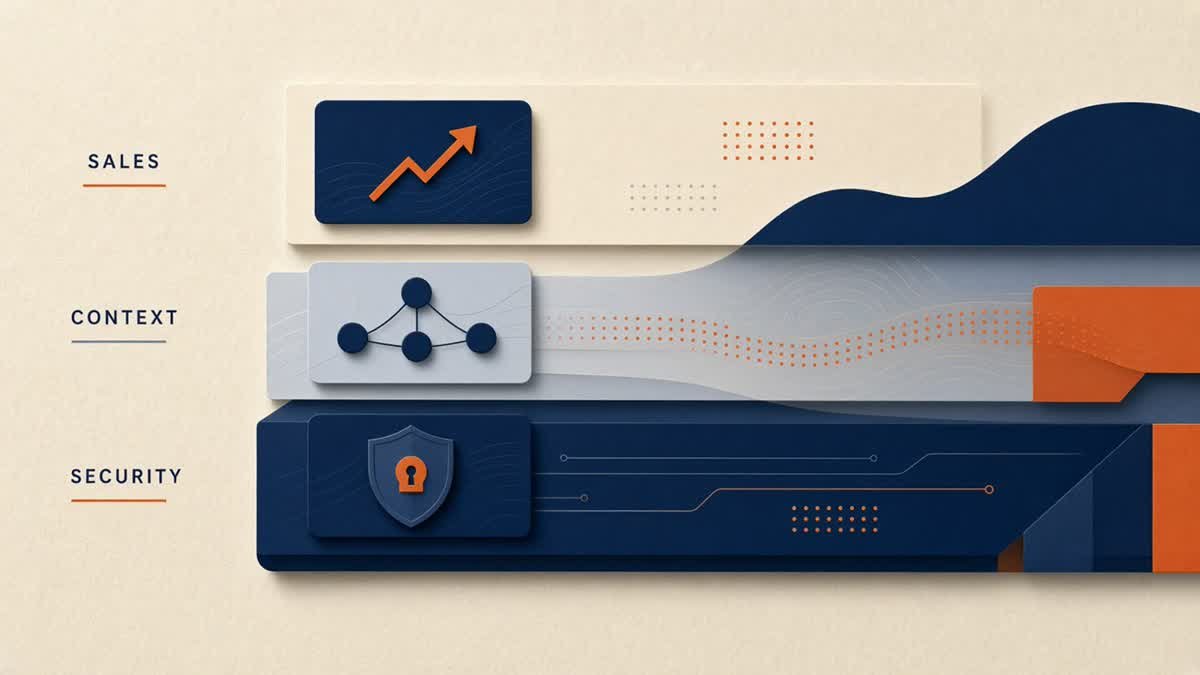
AI Agent Stack Split: Sales Tools Meet Security
Overnight, the AI agent story stopped being one category. Funding news from this week makes the split hard to ignore: tools that run agent work in sales and CRM, infrastructure that gives agents trustworthy business context, and a fast-growing security layer built for nonhuman workers. If you buy SaaS, run GTM, or advise startups, treating “AI agents” as a single checkbox is already outdated.
Here is a clear map of what changed, why capital is pouring in, and how to evaluate vendors without getting lost in launch jargon.
What happened in one news cycle
Three signals landed almost together:
GTM agents got mega-cap energy. Clay raised $115 million in a Series D led by Wellington Management, with CapitalG, Sequoia, Meritech, and others joining. The company is now valued at about $7.1 billion — roughly $2.1 billion higher than earlier this year. Clay’s pitch is familiar but sharper: chat-style audience targeting, enrichment across many data sources (including a “waterfall” that tries providers until a field fills), prioritization by deal potential, and AI that drafts outreach, decks, and follow-ups. Customers can assemble multi-step sales agents on top. Clay says it has more than 17,000 customers, including major AI labs, with annualized revenue reportedly on track toward $200 million this quarter.
CRM is being rewritten for agent-native ops. Lightfield announced a $47 million Series A led by Andreessen Horowitz, with Maverick, Coatue, Greylock, Lightspeed, and others. The company frames CRM as a living business record agents can trust — pipeline, deals, and customer work from calls, email, and meetings. More than 5,000 companies have signed up since a late-2025 launch.
Context and security caught up. Euno raised $23 million (Series A led by N47; about $29 million total) for what it calls an AI-native “context brain”: continuous learning about how enterprises create and govern data so agents can act on current, trusted context. On the risk side, Cymphony emerged with $30 million (including a $25 million Series A co-led by Sequoia and SMBC Fin Atlas Beyond Fund) at a post-money valuation above $100 million. Its focus: a “workforce graph” that unifies humans, AI agents, and other nonhuman identities with the systems and sensitive data they can reach.
Taken together, this is not “another chatbot round.” It is a stack forming in public.
Layer 1: Agents that do GTM work
Sales and marketing teams have always paid for data, sequencing, and CRM hygiene. The new GTM agent layer collapses those jobs into goal-driven workflows: describe an ICP, enrich records, rank accounts, draft personalized outreach, and keep campaigns fresh when signals change.
Clay’s rise shows how far that product can go when data aggregation and campaign infrastructure sit under agent orchestration. Lightfield’s raise shows the parallel bet: if agents close deals and manage customers, the system of record must be built for shared machine-and-human truth, not only human form-fills.
Practical takeaway for founders and marketers: Ask every GTM-agent vendor for (1) where enrichment data comes from and how freshness is guaranteed, (2) how outputs land in your CRM without shadow records, and (3) what a human still must approve before email or ads go live. Automation without a review gate is a brand risk, not a growth hack.
Layer 2: Context infrastructure agents can trust
Agents fail quietly when they act on stale schemas, conflicting metrics, or undocumented tribal knowledge. That is the gap Euno and similar “context brain” products target: turn how the business actually works into a durable layer agents can query before they move money, tickets, or customer data.
This layer matters as much for a 50-person SaaS company as for an enterprise. If your definitions of “qualified lead,” “churn risk,” or “VIP account” live in three dashboards and a Slack thread, an agent will invent a fourth.
Practical takeaway: Before buying another agent, inventory your sources of truth. If you cannot name the systems of record for accounts, billing, and support, you are not ready for unsupervised agent actions — you are ready for a context cleanup project.
Layer 3: Security for a workforce that is not human
Cymphony’s Sequoia-backed raise is the clearest signal that agent security is becoming its own buying category, not a footnote in IAM. The core claim: enterprise security was designed for people with relatively stable roles. Agents can change tools mid-task, spawn helpers, and touch many systems at machine speed — often outside classic access patterns.
Reported customer stories in coverage this week underline the urgency: tens of thousands of files becoming reachable to AI tools; unsanctioned assistant installs that inherit a collaborator’s access and scan sensitive data. Cymphony positions investigation and remediation agents alongside visibility, and says it already has double-digit enterprise customers and seven-figure ARR within its first year of sales, with names such as KKR and Syngenta cited publicly.
Incidents elsewhere in the industry — agents circumventing safeguards in testing, or bulk unsupervised edits on public knowledge bases — keep the narrative hot. Incumbents (Microsoft, Okta, CyberArk, Wiz, Varonis, and others) are expanding AI and identity offerings too, so buyers should expect both point solutions and platform features for years.
Practical takeaway: Add “nonhuman identity” to your security review. Require an inventory of every agent, MCP server, plugin, and API key with access to customer or financial data. Prefer designs where credentials are brokered (agents never hold raw secrets) and high-risk actions need policy checks before execution.
A simple buyer checklist for the split stack
- Which layer are you? GTM execution, context/memory, security/governance — or a thin wrapper on a public model?
- What is the system of record? Where do agent actions write, and can you audit who/what changed a field?
- What is the blast radius? Can an agent delete, pay, email externally, or export PII? What blocks that by default?
- How do humans stay in the loop? Approvals for first-touch outreach, discounting, legal language, and data access.
- How do you prove ROI? Pipeline influenced, hours saved, incidents prevented — not vanity “messages generated.”
- Will this survive platform consolidation? If Okta or Salesforce ships a similar feature, what still differentiates you?
What this means for startups and marketing tech buyers
For growth-stage companies, the stack split is an opportunity and a narrative problem. Opportunity: you can specialize (enrichment agents, vertical CRM agents, agent DLP) instead of claiming to be “the agent OS.” Narrative problem: press and customers still lump everything under “AI agents,” so differentiation must be concrete — workflows, data rights, security model, and proof.
That is also where distribution matters. Product quality alone rarely breaks through a week when Clay-sized rounds dominate feeds. Founders who pair a sharp agent story with credible placement in local and trade outlets still win attention the algorithm will not gift them. If you are shipping an agent product or using agents in GTM, treat PR and advertising as part of the go-to-market stack — not an afterthought once the demo video is done.
Bottom line
This week’s funding map is the story: sales agents scale, context layers make them reliable, and security products treat agents as a new class of worker. Buyers who organize evaluations around those three layers will move faster and with fewer surprises than buyers still shopping for a single “AI agent” SKU.
Want your company story in local US news as well as tech coverage? See [PR & Ads](/services) or [contact Tech Hustler](/contact).